


0571-26692003
No. 181 Geyazhuang, Xihu District,Hangzhou, Zhejiang, P.R. China

Recently, the research team led by Professor Kehui Wu from Tsientang Institute for Advanced Study, in collaboration with Zhejiang University, Institute of Physics, Chinese Academy of Sciences, and other institutions, achieved a significant breakthrough in the field of functional oxide thin films. The related research findings, titled “Templated Perpendicular Ferroelectricity in Textured Aurivillius Oxide-based Thin Films,” were published in the top-tier international academic journal Nature Communications on March 13, 2026, with Tsientang Institute for Advanced Study serving as the primary institution.
Functional oxide thin films, owing to the strong coupling among spin, orbital, charge, and lattice degrees of freedom, exhibit rich physical properties such as superconductivity, ferromagnetism, and ferroelectricity, making them a central topic in condensed matter physics and functional materials research. In-depth exploration of the intrinsic physical characteristics and regulatory mechanisms of these functional oxide thin films not only reveals the intrinsic connections between microstructure and macroscopic functionality but also provides promising candidate material systems for the development of novel semiconductor devices.
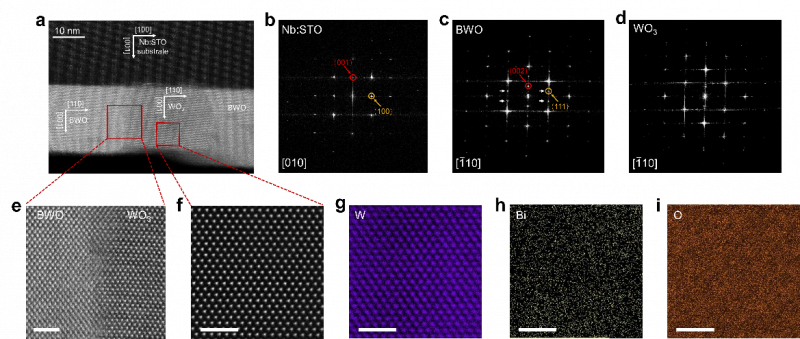
Figure 1. Atomic-scale characterization of textured two-component WO₃/ Bi₂WO₆ films.
Based on this, Professor Kehui Wu’s team successfully developed a structural templating strategy. By stabilizing a metastable WO₃ phase within the lattice framework of the Aurivillius-phase oxide Bi₂WO₆, they successfully prepared textured WO₃/ Bi₂WO₆ thin films. This material achieves robust out-of-plane ferroelectric polarization, a stark contrast to the pristine Bi₂WO₆ material, which exhibits only in-plane polarization characteristics. Combined with first-principles calculations and atomic-resolution scanning transmission electron microscopy, the study revealed that the ferroelectric polarization of this WO₃ phase originates from the displacement of oxygen ions.
Prototype ferroelectric field-effect transistors and ferroelectric memristors fabricated based on this thin film demonstrated an excellent on/off ratio exceeding 10⁶ and thermal stability up to 350°C. This research not only expands the material system of binary ferroelectric oxides but also establishes a universally applicable design paradigm to overcome the limitation of constrained polarization directions in layered ferroelectric materials.
The first authors of this study are Dr. Song Zhou, supervised by Professor Kehui Wu, along with co-first authors Dr. Shulin Zhong from Zhejiang University, Dr. Songge Zhang from The Hong Kong Polytechnic University, and Dr. Lei Liao from the Institute of Physics, Chinese Academy of Sciences. The primary corresponding author is Professor Kehui Wu, with other corresponding authors including Professor Yunhao Lu from Zhejiang University, and Professors Guangyu Zhang and Xuedong Bai from the Institute of Physics, Chinese Academy of Sciences. This research was supported by the National Key Research and Development Program of China, the Zhejiang Provincial Natural Science Foundation of China, and the Hangzhou Tsientang Education Foundation.
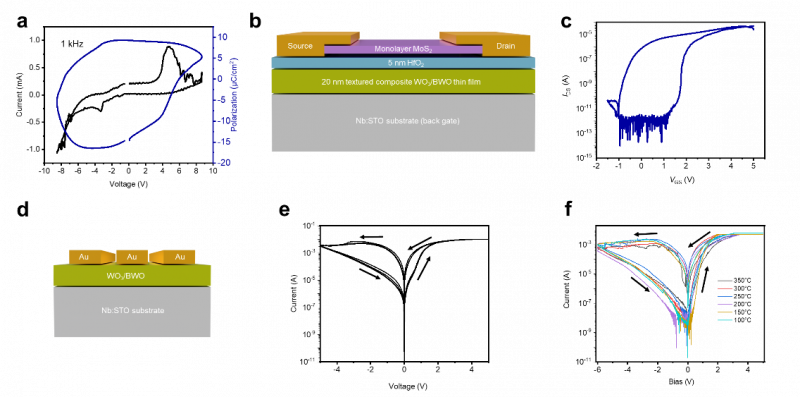
Figure 2. Macroscopic ferroelectric polarization and ferroelectric device characteristics of textured nanocomposite WO₃/Bi₂WO₆ thin films.


