


0571-26692003
No. 181 Geyazhuang, Xihu District,Hangzhou, Zhejiang, P.R. China

When Classical Computing Hits the Wall
New Computing Possibilities Emerge
Amid Great-Power Tech Rivalry
Quantum Computing
—Once a Distant Frontier—
Moves Into Reality
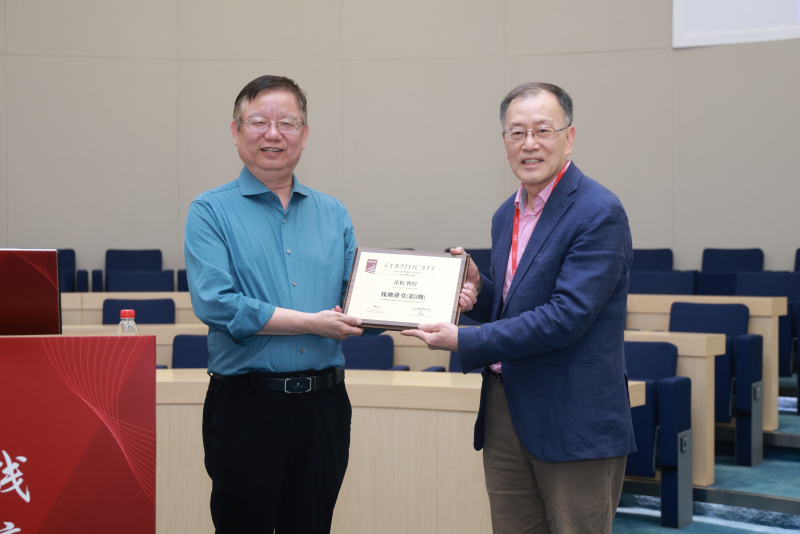
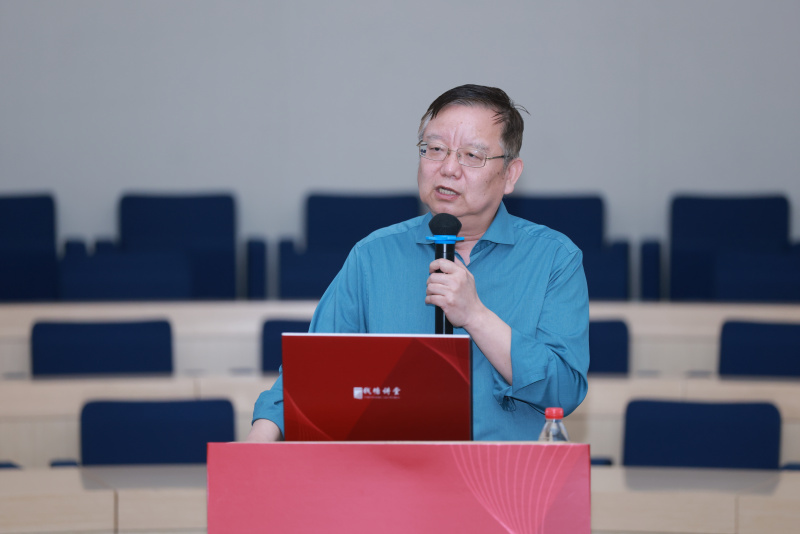
The 5th Tsientang Lectures session kicked off as scheduled on March 24. The session featured a special presentation by Researcher Heng Fan from the Institute of Physics, Chinese Academy of Sciences. His talk, titled "Frontiers of Quantum Computing: Major Power Rivalry and Technological Transformation", demystified quantum computers in plain and accessible language. From core principles to technological breakthroughs, and from the global competitive landscape to China's innovative achievements, Fan presented an overview of the latest frontiers in quantum computing. He guided the audience to reflect on the direction of the next-generation computing power revolution, delivering a rigorous yet engaging lecture on quantum science and technology.
Endless Computing Revolution
Classical computers encode information in bits, each representing either 0 or 1. Quantum computers, in contrast, are built on qubits, which exploit superposition, entanglement, and interference to enable parallelism and exponential speedup.
At the outset of the lecture, researcher Heng Fan emphasized that quantum computing is not merely a faster form of classical computing, but an entirely new computational paradigm. Its emergence is expected to reshape the foundational frameworks of cryptography, materials research and development, molecular drug design, and artificial intelligence (AI).
To make abstract quantum theory more accessible, he introduced the three core phenomena: superposition, entanglement, and interference, using intuitive comparisons between classical bits and qubits. Based on research recognized by the 2025 Nobel Prize in Physics for the discovery of macroscopic quantum mechanical tunneling and energy quantization in an electric circuit, he clarified the scientific basis of superconducting quantum computing, helping the audience grasp its core principles and capture the distinctive nature of the quantum world.
The Pursuit of Quantum Advantage
In a clear and measured narrative, researcher Heng Fan traced the evolution of quantum computing, from the discovery of fundamental quantum phenomena to the development of superconducting quantum chips and the emergence of cloud-based quantum platform services. Step by step, quantum advantage is moving from theoretical possibility toward experimental reality.
He then mapped the major global technology pathways, outlining strategic priorities and investment trends across China, the United States, and Europe, while assessing the shifting dynamics of international competition. He underscored the importance of technological self-reliance in critical hardware and core systems. As a leading figure in China's superconducting quantum computing efforts, Heng Fan also highlighted key advances from his team. These include the development of the Quafu quantum computing cloud platform, which serves users in more than 30 countries and supports a broad range of high-level research. He further reported the successful realization of a 78-qubit "Zhuangzi 2.0" superconducting quantum chip, demonstrating multi-drive prethermalization and performance beyond classical algorithms and providing evidence of practical quantum advantage. The results, published in Nature, mark a significant step forward in superconducting quantum simulation and place this line of research at the forefront of the field.
A New Launch Point for Future Industries
“Quantum computing is moving beyond the lab to become a foundational driver of future industry,” said researcher Heng Fan. He argued that its impact will extend across cryptosecurity, financial optimization, new materials development, and quantum AI, positioning it as a strategic frontier for next-generation productivity and global technological leadership. In an era of intensifying great-power rivalry, he noted, the pace and sophistication of quantum computing will play a decisive role in shaping a nation’s position in the future technology landscape.
Q&A
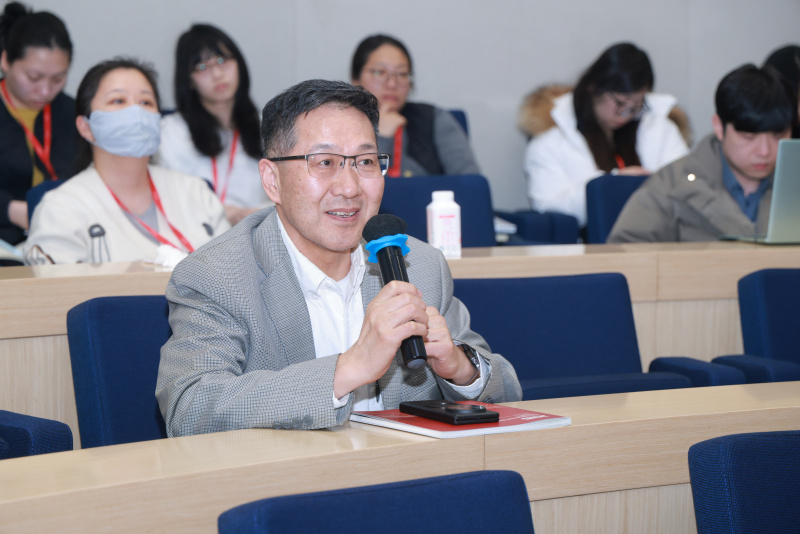
Question: What are the main challenges in quantum error correction today, and what progress is expected in the future?
Heng Fan: The error rates of quantum computers remain significantly higher than those of classical systems, making this the central challenge for quantum error correction. Classical computers typically achieve error rates as low as 10-18 to 10-20, effectively rendering errors negligible. By contrast, current quantum computers exhibit single-qubit gate error rates on the order of 5×10⁻³, leading to rapid error accumulation in large-scale computations and ultimately compromising the reliability of results. To address this, researchers rely on quantum error-correcting codes. For example, seven physical qubits are used to encode one higher-fidelity logical qubit. Errors arising during quantum information storage are first detected, after which auxiliary qubits are used to identify the type of error and correct it. However, this approach is highly resource-intensive; practical deployment may require on the order of hundreds of physical qubits per logical qubit. Looking ahead, the short-term goal is to reduce gate error rates from 5×10⁻³ to -6. Over the next decade, the long-term target is 10-13. Only substantial reductions in gate error rates will make quantum computers truly practical for real-world applications.
Question: What is the outlook for superconducting quantum computing in large AI models?
Heng Fan: From a hardware standpoint, superconducting quantum computing is relatively easy to integrate with existing supercomputing systems.The measurement and control systems used in superconducting quantum computing are relatively compatible with existing supercomputing infrastructure. Quantum computing outputs can be directly processed by classical systems, with no significant barriers in communication or technological integration. However, the most significant challenge at present is the high error rates of quantum computers. In the 53-qubit "quantum supremacy" experiment conducted in the United States, for example, the success probability of obtaining the target output was only on the order of 10⁻³, and valid results could not be reliably distinguished from erroneous samples. This makes it difficult to apply such systems directly to large AI models requires high numerical precision. Looking ahead, meaningful integration between superconducting quantum computing and large AI models will depend on identifying suitable demonstration schemes in which quantum-classical approaches can outperform either classical-only or quantum-only methods. This remains a key research direction for the team.
Question: Today, quantum computing development is largely benchmarked by "qubit count". Should the field adopt a clearer phased roadmap?
Heng Fan: This is a highly important question and a central issue that has been widely discussed within the academic community. At present, global quantum computing development does show a tendency to compete primarily on "qubit counts". However, as a major scientific and technological endeavor, the field should not be driven solely by numerical scaling. Instead, it requires clearly defined phased objectives and milestones, similar to accelerator physics, where progress is evaluated through explicit performance metrics such as particle acceleration rates and energy parameters. Looking ahead, quantum computing development should be guided by stage-specific benchmarks, including achievable qubit scales, acceptable error-rate thresholds, advances in error-correction capabilities, and the size of quantum systems that can be reliably simulated. China holds institutional advantages in this field, with universities and research institutes having formed strong core research teams. Going forward, closer collaboration across the academic community is needed to propose a quantum computing development roadmap with Chinese characteristics, advancing progress in a structured, phased manner and avoiding purely metric-driven competition.
Tsientang Lectures, established by Tsientang Institute for Advanced Study (TIAS), serves as an elite intellectual exchange platform dedicated to dismantling knowledge barriers and broadening academic horizons. Guided by the core philosophy of "Knowledge Beyond Boundary", it convenes global wisdom by inviting world-leading scholars to transcend geographical, disciplinary, and cultural divides, kindling the flame of inquiry with sparks of thought.
Follow the Tsientang Lectures as we explore the frontiers of science and open new horizons in scientific discovery!


