


0571-26692003
No. 181 Geyazhuang, Xihu District,Hangzhou, Zhejiang, P.R. China

Recently, a team of Chinese scientists has achieved a significant breakthrough in the field of two-dimensional materials by successfully synthesizing and characterizing a nitrogene-like two-dimensional nitrogen crystalline structure on silver (100) surfaces through experimental methods. Published in Nature Communications (2025) https://doi.org/10.1038/s41467-025-67552-4, this research reveals the possibility of nitrogen forming stable crystalline structures in the two-dimensional limit, opening new avenues for ultra-wide bandgap materials in ultraviolet optoelectronics and high-k dielectric applications.
The research team employed ion-beam-assisted epitaxy (IBAE) technology, optimizing the kinetic energy of nitrogen ions (approximately 30 eV) and substrate
temperature (400±10 K), to successfully achieve high-quality growth of two-dimensional nitrogen crystals on Ag(100) surfaces. Scanning tunneling microscopy (STM) and low-energy electron diffraction (LEED) results show that the structure forms a (√2×√2)R45° superstructure relative to the silver substrate with a lattice constant of 4.2 Å. Angle-resolved photoemission spectroscopy (ARPES) and scanning tunneling spectroscopy (STS) measurements reveal that this nitrogene-like structure exhibits an ultra-wide electronic band gap of approximately 7.5 eV, significantly larger than most known two-dimensional materials.
Through first-principles calculations, the research team determined that this two-dimensional nitrogen crystal has a puckered honeycomb lattice structure, similar to black phosphorus. This structure gains stability on the silver surface through interaction with a buffer layer of stoichiometric AgN composition. Although nitrogene is thermodynamically less stable than nitrogen molecules in its free state, it can be stabilized on the silver substrate through interaction with the buffer layer, enabling its experimental realization under the growth conditions.
The significance of this research lies not only in the first experimental confirmation of the theoretically predicted nitrogene structure but also in demonstrating the unique chemical behavior of nitrogen in the two-dimensional limit. This stable two-dimensional nitrogen crystal has tremendous application potential, with its ultra-wide band gap making it an ideal candidate for ultraviolet detectors, light-emitting devices, and high-k dielectric materials. Additionally, this material exhibits good stability at room temperature, enabling its potential application in practical devices.
This research was collaboratively conducted by multiple institutions including the Institute of Physics, Chinese Academy of Sciences (IOP, CAS); School of Physical Sciences, University of Chinese Academy of Sciences (UCAS); Max Planck Institute of Microstructure Physics (MPI); the Tsientang Institute for Advanced Study, Zhejiang (TIAS); and the Interdisciplinary Institute of Light-Element Quantum Materials at Peking University. Team leader Dr. Baojie Feng (IOP) conceived the research and designed the experimental approach; Dr. Lan Chen (IOP), Dr. Sheng Meng (IOP), and Dr. Kehui Wu (TIAS) provided crucial guidance on experimental design and data analysis; and young researchers Xuegao Hu, Haijun Cao, Zhicheng Gao, and Hui Zhou carried out sample preparation, STM/LEED/ARPES characterization, and theoretical calculations. This work was supported by multiple funding sources including the National Key R&D Program of China, the National Natural Science Foundation of China, the Beijing Natural Science Foundation, and the CAS Project for Young Scientists in Basic Research, demonstrating China's leading international position in the research of novel two-dimensional materials.
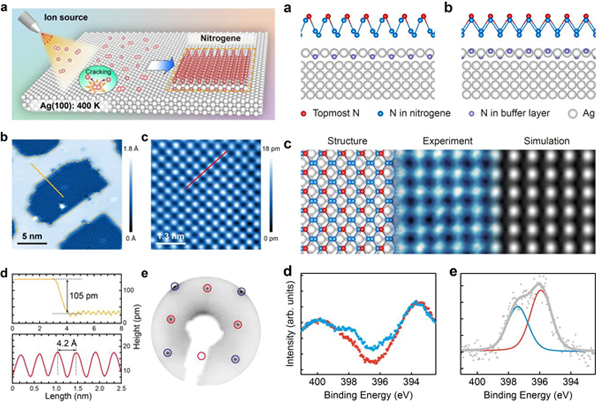
Fig.1 Growth and atomic structure of nitrogene-like structures on Ag(100).
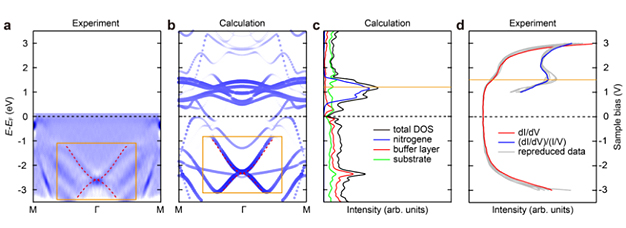
Fig.2 Electronic structures of the nitrogene-like structure on Ag(100).


