


0571-26692003
No. 181 Geyazhuang, Xihu District,Hangzhou, Zhejiang, P.R. China

On May 12, 2025, Professor Eberhard Gross delivered an academic lecture. In this lecture, time-dependent density functional theory (TDDFT) was presented as a versatile ab-initio method designed to simulate the dynamics of electronic systems. While many applications had employed TDDFT to predict the response to weak probes, thus providing an efficient description of spectroscopic data, this lecture focused on real-time TDDFT simulations of the dynamical behavior far from thermal equilibrium. The goal was to monitor, analyze and, ultimately, control the electronic motion with ultra-short laser pulses.
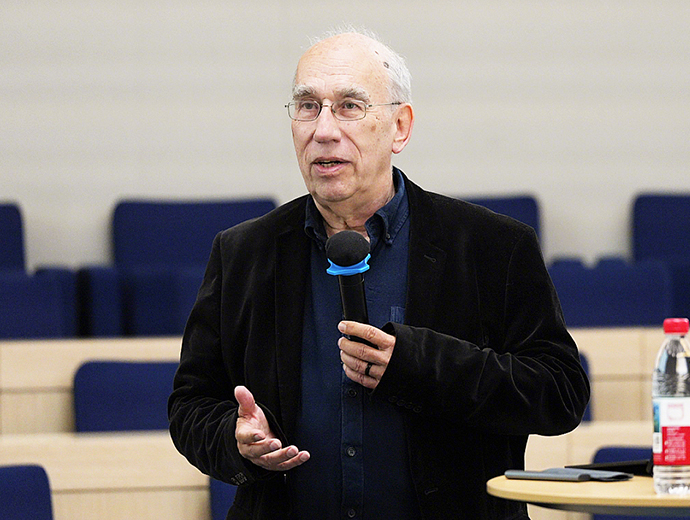
Professor Gross visualized the laser-induced formation and breaking of chemical bonds in real time, and he highlighted non-steady-state features of the electronic current through nano-scale junctions, such as undamped charge oscillations representing a real-time picture of Coulomb blockade. Furthermore, the electronic current through the junction could trigger nuclear motion within the junction, resulting from a subtle interplay of electronic friction and the current-induced push on the nuclei.
With the goal of taking magnetic storage processes to faster and faster time scales, Professor Gross and his team had predicted that in suitable materials, the local magnetic moment could be manipulated with ultrafast laser pulses on the femto- and even atto-second timescales. The underlying mechanism was an optically induced spin transfer (OISTR) from one magnetic sub-lattice to another. OISTR was first predicted by TDDFT calculations and found experimentally two years later. The OISTR effect marked the birth of “atto-magnetism”.


