


0571-26692003
No. 181 Geyazhuang, Xihu District,Hangzhou, Zhejiang, P.R. China

On July 3, 2025, 2016 Nobel Prize in Physics laureate, Professor John Michael Kosterlitz, delivered a compelling lecture titled "A Random Walk Through Physics to a Nobel Prize" at the Tsientang Institute for Advanced Study. The event not only offered profound insights into his groundbreaking research on topological phase transitions but also revealed his personal journey from academic beginnings to scientific eminence.
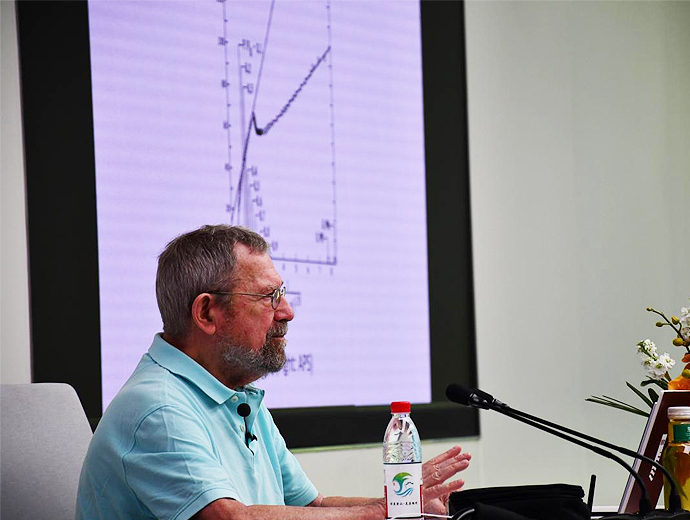
Professor Kosterlitz was jointly awarded the 2016 Nobel Prize in Physics, alongside D.J. Thouless and F.D.M. Haldane, for their discovery of topological phase transitions in classical systems. A graduate of the University of Oxford (PhD, 1969), he has been a Professor of Physics at Brown University since 1982. His distinguished career includes receiving the Onsager Prize from the American Physical Society (2000) and election to the U.S. National Academy of Sciences (2017), solidifying his influence in condensed matter physics.
Professor Kosterlitz used the metaphor of a "random walk" to describe his academic trajectory, emphasizing curiosity and interdisciplinary exploration as key determinants. Early Academic Foundations: He recalled his doctoral years at Oxford, where he cultivated a rigorous approach to merging theoretical derivations with experimental observations.
The lecture centered on the Berezinskii-Kosterlitz-Thouless (BKT) theory, unraveling its development and impact:
Theoretical Framework: Professor Kosterlitz explained the interplay between smooth phase variations and vortices in system dynamics, deriving relationships between free energy, vortex fugacity, and other key quantities. He demonstrated how perturbation expansions in small vortex fugacity (assumed valid due to large vortex core energy) laid the foundation for the model.
Renormalization Group Analysis: He presented renormalization group flows in the (K, y) plane, illustrating the scaling of vortex core size. The transition temperature Tc(y) emerged as a critical feature: a line terminating at y(l)=0 and K(l)=2/π as l approaches infinity.
Predictions and Experimental Validation: Core predictions - including changes in stiffness, correlation length, and superfluid density across phase transitions - were validated with experiments by D.J. Bishop and J.D. Reppy (1978). Further evidence from colloids and electrons-on-helium systems confirmed the theory’s universality.
Professor Kosterlitz’s lecture wove together personal anecdotes and scientific rigor, showcasing how curiosity, global collaboration, and life’s diverse experiences fuel breakthroughs. As he put it, "Physics is a random walk - but every step, guided by passion, leads closer to understanding." The lecture left attendees inspired by both his contributions to topology and his philosophy of embracing the unexpected in science and life.


