


0571-26692003
No. 181 Geyazhuang, Xihu District,Hangzhou, Zhejiang, P.R. China

Recently, researchers from the Acoustics Materials and Chip Team of Laboratory of Quantum Materials, in collaboration with Peking University, Songshan Lake Materials Laboratory, and other institutions, have achieved a significant breakthrough in the field of two-dimensional (2D) material-based acoustic sensing. They have innovatively proposed a pressure-assisted double transfer strategy for the constructing of large freestanding 2D material-based membranes. They have successfully fabricated centimetre-scale (largest of 8 cm) tensioned freestanding membranes with and a thickness of only 80 nm and a large D/h ratio (~106), and achieved pressure sensor and microphone with highly sensitive and excellent signal-to-noise ratio.
The core performance of acoustic devices is generally determined by the mechanical responsivity of freestanding membranes. Theoretically, larger and thinner membranes are more sensitive to weak acoustic or pressure waves. Nevertheless, for conventional bulk materials (such as metals, polymers and silicon), it is extremely difficult to simultaneously achieve both large lateral dimensions and ultrathin thickness. Their low tensile fracture strength at the nanometre scale severely limits the achievable geometric aspect ratio of freestanding structures. 2D materials are ideal candidates for high-sensitivity acoustic detection due to their atomically thin geometry and exceptional mechanical properties. However, constrained by existing transfer methods, large freestanding 2D materials are highly prone to defects including cracks, voids, excessive wrinkles and random localized stress during the suspension process, which greatly impedes the further improvement of acoustic devices.
The research team proposed an innovative strategy to fabricate large freestanding membranes and demonstrated ultrahigh-sensitivity acoustic sensing devices. By adopting a sacrificial-layer-free pressure-assisted two-step transfer method combined with internal stress tuning of the membrane, the team achieved the reliable fabrication of large freestanding membranes, the team successfully fabricated freestanding 2D material membranes with a maximum suspended diameter of 8 cm and a diameter-to-thickness ratio as high as 10⁶. For the performance of the devices, the large freestanding membrane has a static pressure responsivity of up to 500 μm/Pa, more than four orders of magnitude higher than that of traditional silicon-based materials; the microphone based on the large freestanding membrane has a wide response bandwidth covering the human audible range to the ultrasonic range (100 Hz–50 kHz), and possesses excellent dynamic signal-to-noise ratio of up to 115 dB at 1 kHz, reaching an international leading level; meanwhile, in far-field speech recognition tests, it shows better recognition accuracy than commercial MEMS microphones, maintaining an accuracy rate of more than 60% even at a distance of 15 meters.
The study provides a novel material system and a reliable route for breaking through the limit of traditional acoustic devices. The proposed highly sensitive acoustic devices based on large freestanding 2D material membranes are expected to promote the development of multi-perception systems such as high-end audio equipment, intelligent communication interaction and acoustic early warning systems.
The study was jointly conducted by the co-first author Dr. Yuebin Zheng, the co-corresponding authors Associate Professor Kehai Liu and Professor Enge Wang from the Tsientang Institute for Advanced Study, together with Professor Kaihui Liu’s group from Peking University. The findings were published on May 06, 2026,in Nature Communications (https://doi.org/10.1038/s41467-026-72771-4). This research was supported by the Guangdong Major Project of Basic and Applied Basic Research, the Hangzhou Tsientang Education Foundation, and related fundings.
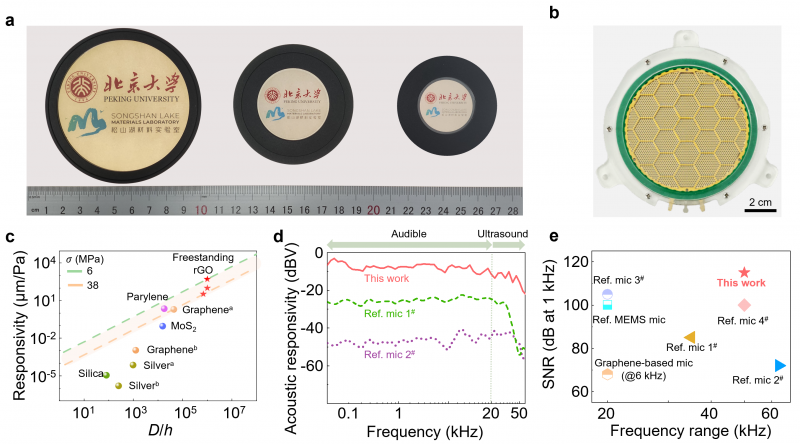
Figure 1. Large freestanding Graphene membranes and highly sensitive acoustic devices


